 RoboSpark
Machine vision & sensing
Multi-camera rigs, depth fusion, barcode and pose estimation pipelines tuned to your lighting and throughput targets. We ship ONNX and TensorRT models with documented retraining paths.
RoboSpark is a Canadian AI-for-robotics engineering services firm on Sterling Road, Toronto — a prototyping studio where human engineers and operators stay in the loop on every build. We design robot perception, motion planning, control systems and automation cells for manufacturers and logistics operators. We are not a consumer robot store, not a weapons maker, not surveillance, not a SaaS product or course, and we do not guarantee specific ROI or a zero-incident, hands-off factory. When a pick-and-place cell jams because a box arrives skewed by three degrees, or a vision model reads a shadow as a part and stops the line — that is the work we take on.
Most robotics projects stall when vision, kinematics and embedded software are handled by separate vendors. At RoboSpark, mechanical engineers, perception specialists and firmware developers share the same workcell floor. That means your camera calibration informs the gripper design on the same afternoon, not three sprints later.
We work with industrial arms, mobile platforms, custom end-effectors and edge compute rigs. Whether you need a pick-and-place cell validated against your SKU mix or a mobile manipulator that navigates uneven warehouse floors, the build stays inside our Toronto lab until it earns a field trial.
How we engineer
Multi-camera rigs, depth fusion, barcode and pose estimation pipelines tuned to your lighting and throughput targets. We ship ONNX and TensorRT models with documented retraining paths.
Trajectory planning, force-controlled grasping, mobile base navigation and safety-rated stop circuits. Every motion profile is logged and replayable for regression testing.
ROS 2 nodes, real-time schedulers, PLC handshakes and remote diagnostics. Firmware updates ship with checksum verification and rollback hooks.
Our Suite 105 facility houses calibrated workcells, a parts crib stocked for rapid iteration and a metrology bench for sub-millimetre verification. Clients visit for design reviews, watch live demos and sign off on acceptance criteria before anything leaves Toronto.
We document every build with wiring diagrams, BOM snapshots and operator runbooks. When your internal team takes over maintenance, they inherit a system they can actually service — not a black box that only we understand.
The lab runs two acceptance shifts per week — Wednesday evenings and Saturday mornings — so clients who cannot visit during business hours still witness recorded test runs with live commentary from the assigned engineer. Remote dial-in is standard; on-site attendance is optional but recommended at least once before handover.

These sketches describe past-style work — not promises of future results. Names and facilities are anonymised.

A packaging line stopped whenever cartons arrived three degrees off-square. We rebuilt the perception pipeline with engineer-in-the-loop validation, tuned motion planning for the robotic arm, and ran functional-safety checks against ISO 10218 before any production trial.
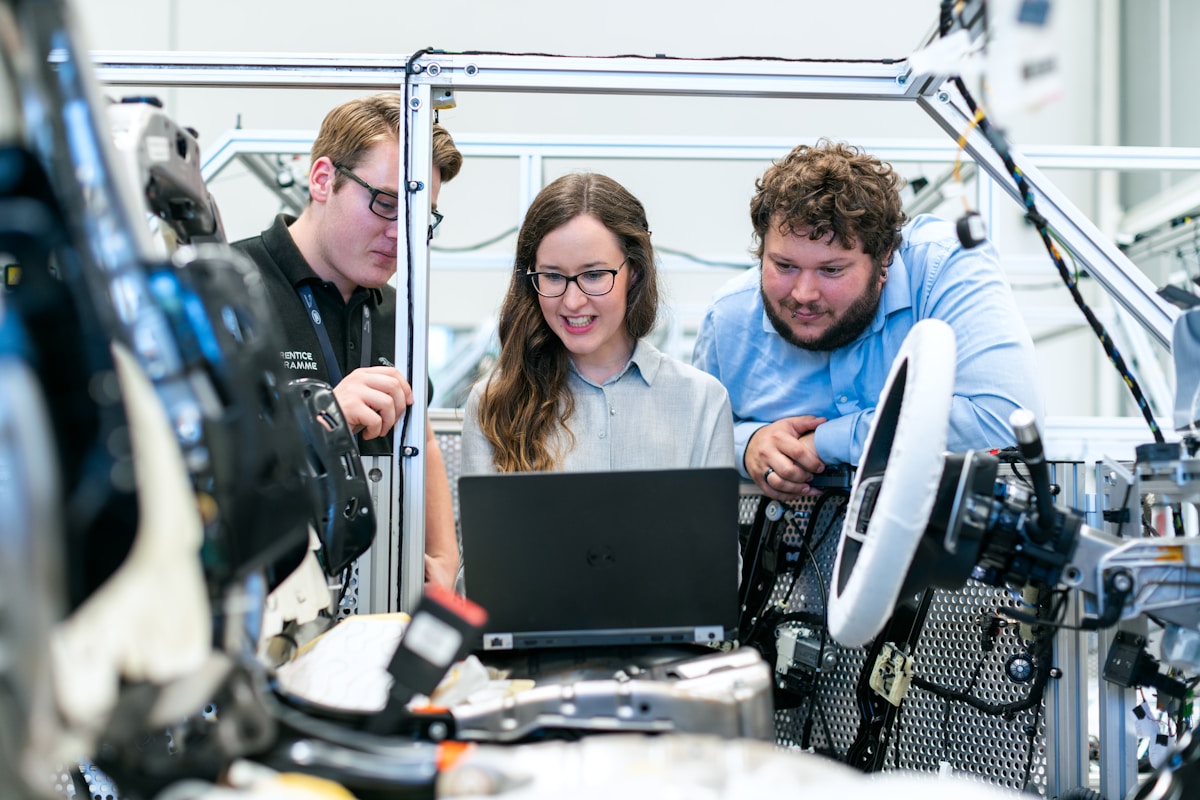
Shadows on a conveyor fooled an edge-AI classifier. Our Sterling Road team added sensor fusion, simulation replay and CSA-aligned safety interlocks — with operators confirming every classification change before the cobot resumed motion.
Our clients arrive with a defined pain point: a line that cannot keep pace, a manual step that scales poorly, or a prototype that needs engineering validation before capital approval. We are not a general IT consultancy — every engagement ends with hardware that moves, sensors that classify, and software that logs results to your standards.
Typical project owners include plant engineering managers, product leads exploring factory automation, and founders building robotics-enabled devices. If you can describe acceptance criteria in measurable terms — cycle time, accuracy rate, downtime budget — we can usually tell you within the first call whether the Sterling Road lab is the right venue for your build.
Most prototype sprints complete within six weeks of kickoff. Retainer clients receive a shared Slack channel with the assigned engineer and weekly written status summaries every Friday by 17:00 ET, regardless of whether a site visit occurred that week.
Tell us what the machine needs to see, where it needs to move and what done looks like. We respond within two business days with a lab availability window.
Scope a robotics build